
Rotator Cuff PT: A Clear Path From Pain to Stronger Movement
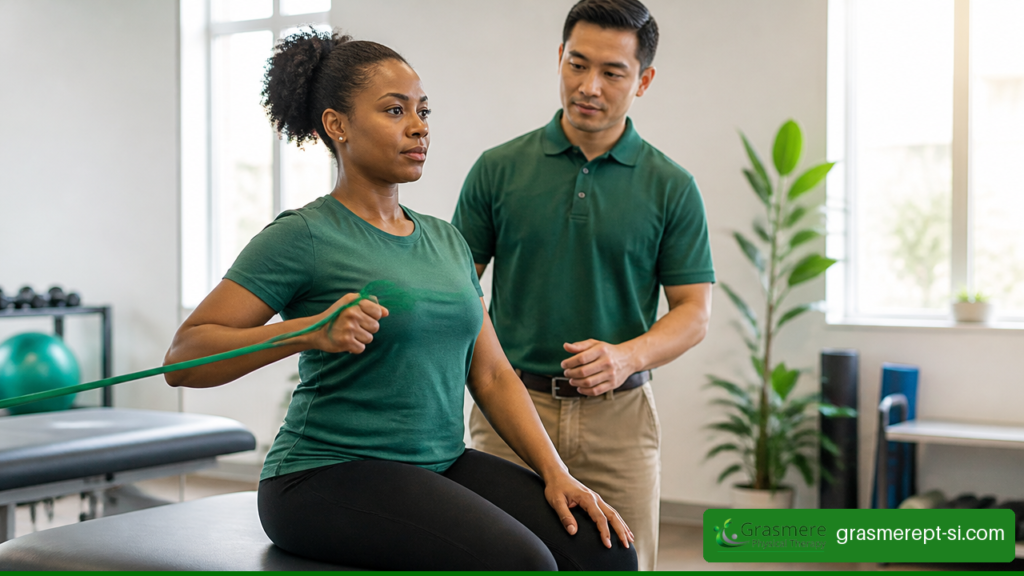
Rotator cuff PT is not a one size fits all set of shoulder exercises. The right plan depends on whether pain comes from tendinopathy, a partial thickness tear, stiffness, or recovery after surgical repair. I want to make that distinction clear because the safest next step can look very different from one diagnosis to another.
Table Of Contents
• Start With The Right Rotator Cuff Diagnosis
• What A Rotator Cuff PT Program Should Include
• Postoperative PT, Reassessment, And Return To Activity
Key Takeaways
• Rotator cuff PT usually starts with an assessment of pain, strength, shoulder motion, neck movement, and the tasks that currently cause trouble.
• Tendinopathy and partial thickness tears may be managed with active rehabilitation, but a full thickness tear needs its own medical and surgical discussion.
• Exercise should build capacity gradually. A harder exercise is not automatically a better exercise.
• Mild, brief discomfort can occur during rehabilitation, but sharp pain, major next day worsening, or declining function should prompt a change in the plan.
• Manual therapy can feel helpful for some people, but it should support an active exercise program rather than replace it.
• After rotator cuff repair surgery, the surgeon’s protocol takes priority. Protecting the repair comes before aggressive strengthening.
Start With The Right Rotator Cuff Diagnosis
What The Rotator Cuff Does
The rotator cuff is a group of four muscles and tendons that help center the upper arm bone in the shoulder joint. It supports lifting, reaching, rotating the arm, and controlling the arm overhead. When the cuff is painful or weak, everyday movements can become surprisingly difficult: placing dishes on a shelf, fastening a seat belt, lifting a child, pulling on a shirt, or reaching behind the back.
Rotator cuff related shoulder pain is an umbrella term. It does not automatically mean a tendon is completely torn. Pain can reflect tendon overload, tendon degeneration, irritation of nearby tissues, reduced shoulder movement, weakness, poor movement coordination, or a combination of these issues.
That is why rotator cuff PT should begin with a careful assessment instead of an internet exercise list. A clinician may look at:
• Which movements reproduce symptoms, such as reaching overhead, lowering the arm, rotating outward, or sleeping on that side
• Active and passive range of motion, meaning how far you can move the shoulder yourself versus how far it moves with assistance
• Strength and control during lifting, rotation, pushing, and pulling
• Shoulder blade movement, thoracic spine motion, neck symptoms, and posture during meaningful tasks
• The timing of the injury, recent changes in workload, and whether trauma was involved
A painful shoulder can also be confused with frozen shoulder, arthritis, neck related symptoms, or nerve irritation. When stiffness is the dominant issue, understanding and managing frozen shoulder can help clarify why treatment may need to focus more heavily on restoring motion before loading the rotator cuff.
Tendinopathy, Partial Tears, And Full Thickness Tears Are Different Paths
The words used in an imaging report matter, but they are not the whole story. Symptoms, function, strength, the injury mechanism, and your goals all influence the care plan.
| Condition | What It Generally Means | Typical PT Emphasis | Important Caution |
|---|---|---|---|
| Rotator cuff tendinopathy | Tendon pain linked with overload or degeneration | Restore comfortable motion, improve control, and gradually build strength | Avoid repeatedly overloading the shoulder while symptoms are highly reactive |
| Partial thickness tear | Only part of the tendon thickness is involved | Similar active rehabilitation, adjusted for pain, weakness, and function | A sudden loss of strength or worsening function needs reassessment |
| Full thickness tear | The tear extends through the tendon | Individual medical evaluation, with PT or surgery decisions based on the whole picture | Do not assume a tendinopathy program is the correct plan |
| Postoperative repair | A tendon has been surgically repaired | Protect the repair, then restore motion and strength in phases | Follow the surgeon’s restrictions and timing |
The 2025 American Physical Therapy Association guideline for rotator cuff tendinopathy includes suspected tendinopathy, calcific cases, and partial thickness tears, but it excludes full thickness tears. That boundary is important. It means evidence based advice for tendinopathy should not be presented as a universal substitute for evaluation of a complete tear.
When Imaging Or Specialist Review May Matter
Not every painful shoulder needs immediate imaging. Many people can begin conservative care after a clinical assessment, especially when symptoms developed gradually and strength is reasonably preserved. Still, imaging or orthopedic review may be more useful when the answer could change the plan.
Consider timely reassessment if you have any of the following:
• Sudden shoulder pain after a fall, dislocation, lifting injury, or other trauma
• A new and obvious inability to raise the arm or rotate it outward
• Progressive weakness that does not match pain alone
• Major loss of motion, worsening symptoms despite an appropriate trial of care, or pain that disrupts sleep consistently
• Numbness, tingling, neck pain traveling into the arm, fever, unexplained swelling, or other symptoms that may point beyond the rotator cuff
For example, a person with a mildly painful but functional shoulder after gardening may reasonably start with activity modification and PT. A person who felt a sudden pop while lifting a heavy object and now cannot actively raise the arm needs a different level of evaluation.
What A Rotator Cuff PT Program Should Include
Active Rehabilitation Is The Center Of Treatment
For tendinopathy and many partial thickness tears, exercise is usually the foundation of care. The current JOSPT clinical practice guideline recommends active rehabilitation that may include motor control and resistance training exercises as initial treatment.
Active rehabilitation does not mean forcing through pain or jumping straight to heavy weights. It means using purposeful movement to improve what the shoulder can tolerate. A program commonly moves through these stages:
- Settle irritability and preserve motion. Early work may include supported arm movement, gentle shoulder rotation, and modifications to painful tasks. If reaching into a high cabinet causes a sharp flare, temporarily use a lower shelf or step stool rather than testing the painful motion dozens of times a day.
- Improve movement control. Motor control work teaches the shoulder, shoulder blade, and trunk to share the task. A light band rotation exercise, for instance, is less about pulling as hard as possible and more about keeping the upper arm steady while the shoulder muscles work in coordination.
- Build strength and load tolerance. Resistance training gradually challenges the cuff and nearby muscles. Exercises may include external rotation, internal rotation, rows, supported elevation, pressing, carrying, or task specific lifting.
- Return to real tasks. A strong exercise in a clinic does not guarantee readiness for painting a ceiling, swimming laps, warehouse work, or tennis. The final phase should resemble the demands you need to return to.
The details matter. A home program of three movements done consistently and correctly can be more useful than ten exercises performed with poor form or too much pain.
How To Progress Without Chasing Pain
There is no universally validated pain rule that fits every rotator cuff condition. Still, symptom response can provide practical information when it is interpreted with function and range of motion.
A useful progression framework is to check four areas:
| What To Check | Signs The Exercise Dose May Be Reasonable | Signs To Reduce Or Reassess |
|---|---|---|
| Pain During Exercise | Mild discomfort that stays manageable and does not alter form | Sharp, catching, escalating, or intolerable pain |
| Range Of Motion | Motion feels the same or gradually easier over time | Motion becomes notably more limited after sessions |
| Function | Daily tasks are stable or improving | Dressing, lifting, sleep, or work tolerance is declining |
| Next Day Response | Symptoms return near the usual baseline by the next day | A flare remains substantially worse into the next day or longer |
This is not permission to ignore pain. It is a way to avoid two unhelpful extremes: treating every sensation as damage or treating severe symptoms as something to “push through.”
Consider a practical example. If band rotations create mild soreness that settles by the next morning and your ability to reach a shelf is unchanged or better, the dose may be tolerable. If the same exercise causes night pain, a marked loss of motion, and worse lifting the following day, lowering the resistance, range, repetitions, or frequency is sensible. A clinician can then determine whether technique, exercise selection, or the diagnosis itself needs review.
For people seeking more condition specific guidance, a plan for shoulder pain relief should connect treatment to the activities that matter most, not just to a pain score.
Motor Control, Strengthening, And Manual Therapy
Motor control exercise and resistance training are not competing camps. They solve related but different problems. Motor control can improve how the arm and shoulder blade move together. Resistance training improves the capacity to handle force. Most programs blend both, then adjust the emphasis based on the person’s limitations.
A 2024 JOSPT review of exercise therapy found that motor control exercise provided modest short and medium term disability benefits compared with nonspecific exercise, but it did not show a significant short term pain advantage. In plain language, better coordinated exercise may help some people do more even if pain does not change dramatically right away.
Manual therapy may include hands on joint movement or soft tissue techniques. It can be useful when pain or stiffness is preventing someone from participating in exercise. But expectations should stay realistic. A systematic review of manual therapy for rotator cuff tendinopathy found about 1.0 to 1.1 points of additional pain reduction on a 10 centimeter pain scale, with uncertain clinical importance.
That average effect is small. It does not mean hands on care is useless, and it does not mean it works equally for everyone. It means manual therapy is best viewed as a possible short term aid that can make active rehabilitation easier, rather than the main engine of recovery.

It is also fair to acknowledge uncertainty. A pooled review of exercise therapy studies found no clear overall difference in shoulder pain between exercise therapy and control interventions. Studies can differ in diagnosis, exercise dose, comparison care, and follow up periods. For you, the practical implication is not that exercise has no role. It is that a program should be individualized, measurable, and revised when it is not improving meaningful function.
Postoperative PT, Reassessment, And Return To Activity
Rotator Cuff PT After Surgical Repair
Postoperative rehabilitation is not simply nonsurgical PT at a slower pace. The repair must heal while the shoulder gradually regains motion and strength. Early restrictions may limit active lifting, weight bearing through the arm, or resistance work. Those limits are determined by the surgeon and can vary with the tear, repair, tissue quality, and other procedures performed.
A typical sequence often includes protected motion first, then active motion, then strengthening, followed by work or sport specific loading. The exact calendar should not override your protocol. Trying to speed up a repair with aggressive stretching or early strengthening can create unnecessary risk.
Some soreness during PT can be expected, particularly when motion is being restored. But severe or escalating pain is not a badge of progress. Communicate what you feel, where it occurs, and how long it lasts. That information helps the clinician distinguish expected treatment sensitivity from a dose that is too aggressive.
A common frustration is the overhead plateau: the arm may rise comfortably to shoulder height but not much farther. Slow progress can occur after surgery, and pain level alone does not tell the full story. Minimal pain with persistent inability to elevate, declining strength, a sudden change after a new incident, or loss of previously gained motion should be reported to the surgical team rather than simply adding more repetitions.
Returning To Work, Lifting, Swimming, Or Sports
Return to activity should be based on the demands of the activity, not just the date on the calendar. Someone returning to desk work may need comfortable keyboard and reaching tolerance. Someone returning to construction, caregiving, swimming, or racquet sports needs repeated overhead strength, endurance, and control.
A staged return often looks like this:
- Restore enough motion for the required task without compensating heavily through the neck or trunk.
- Build strength with controlled loads that match the direction and speed of the task.
- Practice lower demand versions of the real activity, such as lighter lifting, shorter swim intervals, or partial work shifts.
- Increase volume before intensity when possible. For example, add a few controlled lifts before doubling the load.
- Check the response later that day and the next day before progressing again.
The goal is not perfect symmetry on every exercise. It is safe, confident function for your real life. If you are unsure how to adapt activity while recovering, this guide on how to shrug off shoulder pain with a physical therapist’s help offers additional practical context.
Frequently Asked Questions
Can Physical Therapy Heal A Rotator Cuff Tear?
PT cannot be described as healing every tear. It can improve pain, shoulder function, strength, and activity tolerance for many people with tendinopathy or partial thickness tears. A full thickness tear requires individualized medical guidance because the decision between rehabilitation and surgery depends on function, weakness, injury pattern, age, goals, and other factors.
What Exercises Are Usually Prescribed For Rotator Cuff Pain?
Common exercises include supported shoulder elevation, external and internal rotation, rows, shoulder blade control drills, and gradual pressing or carrying. The best exercise depends on your diagnosis, movement limits, and symptom response. An exercise that helps tendinopathy may be inappropriate too early after repair surgery.
Should Rotator Cuff Exercises Hurt?
Some manageable discomfort or muscle fatigue can occur. Sharp pain, catching, worsening form, or symptoms that significantly flare into the next day are signs to reduce the dose and discuss it with your clinician. Pain should be interpreted alongside movement and function, not in isolation.
How Often Should I Do My Home Exercises?
Frequency depends on the exercise type and stage of rehabilitation. Gentle motion work may be assigned more often than strengthening. Rather than copying another person’s schedule, follow the prescribed dose and report whether symptoms, sleep, and daily use improve or worsen between sessions.
Is Resistance Training Better Than Stretching?
They have different roles. Stretching or mobility work may help when stiffness limits motion. Resistance training is usually needed to rebuild capacity for lifting, reaching, and overhead tasks. If a shoulder is highly irritable, heavy strengthening may need to wait until basic movement is better tolerated.
Does Manual Therapy Add Meaningful Benefit?
Manual therapy may provide short term pain relief or make movement feel easier, but the average added pain benefit in research is small. It is most useful when it helps you participate in the active parts of rehabilitation, such as movement practice and strengthening.
How Long Does Rotator Cuff PT Take To Work?
There is no single timeline. A recent flare from overload may improve sooner than longstanding pain, major stiffness, or postoperative recovery. Look for practical trends: easier dressing, improved sleep, greater lifting tolerance, smoother motion, or less recovery time after activity. If those measures are not moving after an appropriate trial, reassessment is reasonable.
When Should I Contact My Surgeon Or Specialist During PT?
Contact the care team promptly after new trauma, sudden loss of strength or motion, increasing swelling, severe persistent pain, fever, or symptoms that do not fit the expected recovery pattern. After surgery, report a meaningful loss of progress instead of trying to work through it alone.
Sources And References
• American Physical Therapy Association — Rotator Cuff Tendinopathy Diagnosis, Non-surgical Medical Care and Rehabilitation: A Clinical Practice Guideline: https://www.apta.org/patient-care/evidence-based-practice-resources/cpgs/CPG_Rotator_Cuff_Tendinopathy_Diagnosis_Non-surgical_Medical_Care_Rehabilitation
• Journal of Orthopaedic & Sports Physical Therapy — Rotator Cuff Tendinopathy Diagnosis, Nonsurgical Medical Care, and Rehabilitation: A Clinical Practice Guideline: https://www.jospt.org/doi/10.2519/jospt.2025.13182
• Journal of Orthopaedic & Sports Physical Therapy — The Efficacy of Exercise Therapy for Rotator Cuff–Related Shoulder Pain According to the FITT Principle: https://www.jospt.org/doi/10.2519/jospt.2024.12453
• Journal of Orthopaedic & Sports Physical Therapy — The Efficacy of Manual Therapy for Rotator Cuff Tendinopathy: A Systematic Review and Meta-analysis: https://www.jospt.org/doi/10.2519/jospt.2015.5455
• PubMed Central — Systematic Review and Meta-analysis of Exercise Therapy for Rotator Cuff-Related Shoulder Pain: https://pmc.ncbi.nlm.nih.gov/articles/PMC13275474/